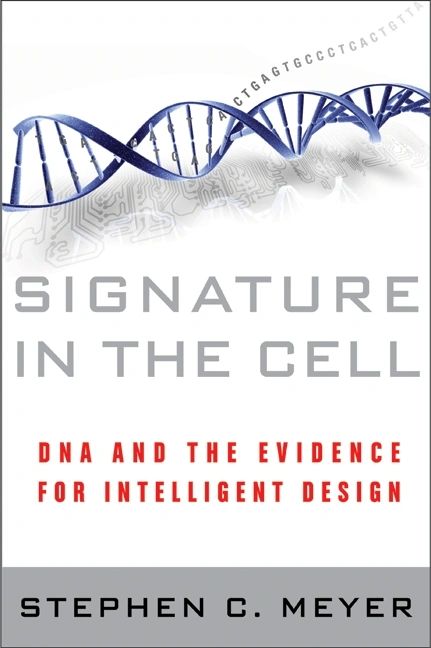
 Signature in a Cell by Stephen G Meyers
 Stephen Meyer's new book, argues that the best explanation of the origin of biological information in the DNA code, is an intelligent cause. How did the coded instruction set in the DNA of the cell originate ? We don't know. However, Dr. Meyers suggests the best explanation is that it was "designed" by an intelligence. Meyer also claims that this specific inference is a scientific argument which was used by Darwin himself, called best inference from the evidence.

 Intelligent Designer
 In 1802, prior to Darwin lifetime, William Paley came up with the Watch Maker Analogy, an argument for the existence of God.
The Wathcmaker Argument goes like this: Suppose while walking on the beach, you find a watch resting in the sand.
Would you conclude that the design of the watch required an intelligent designer, such as a watchmaker?
William Paley's Watchmaker argument continued with the inference that living creatures are more complex than the watch in the sand, and therefore we must have a "Designer". Paley takes then the next step and infers that the designer is God, the Creator of the Universe, the deity of Monotheism.
Above Left image and book cover courtesy of Stephen Meyer.
The Mechanical Age Gives Way to the Information Age
As explained in Stephen Meyer's, Paley's mechanical watch has been replaced by the coded information stored in the instruction set in cellular DNA, a modern discovery yet unknown to Paley or Darwin. Williams Paley's "Watch" in the sand has been replaced by modern day computers and computer code.
Stopping Short with the Inference
Unlike Paley, Meyer does not take the next step, and stops short of inferring the nature of the designer, as this would be outside the realm of scientific exploration. Nonetheless, Meyer goes on to say (off the record) that in his opinion, two possible candidates for the designer are 1) extra-terrestrial beings as suggested by Dr. Crick with his life seeding earth hypothesis. Another candidate is 2) God the Creator. Meyers goes on to say that Big Bang cosmology suggests a cause before the creation of matter, space-time which would be compatible with the idea of a supernatural creator.
Is There Intelligence in Nature?
The claim that there is intelligence (other than human intelligence) in nature has been present in human thought since the ancient times. The inference that this intelligence is God the Creator has also been present for millennia in human records.
A New Package for an Old Idea
What is new about Meyer's presentation is the packaging of the claim in the cloak of a scientific methodology which was used by Darwin himself. This methodology makes Meyer's inference of intelligence in nature a valid scientific endeavor. To be scientific, the claim must be falsifiable, and his book goes through this line of reasoning as well.
Monolith in the Cell
Space Odyssey 2001 by Stanley Kubrick
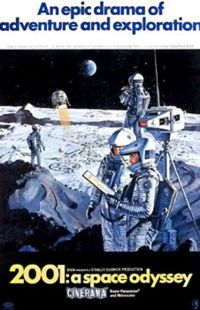
A 1968 movie classic, Stanley Kubrick's Space Odyssey 2001 explores some of the same ideas in the Meyer's Signature in a Cell book.
What Does The Movie Mean?
The web site The 2001 Principle explains Kubrick's movie and the socio-political implications of discovering a non-human intelligence in the universe.
In Kubrick's movie, a large rectangular object called a Monolith is discovered on the far side of the moon, obviously the result of an intelligent civilization.
Left images courtesy of WIkimedia commons
In Stephen Meyer's book, Signature in a Cell, the Kubrick Monolith is replaced by the coded instruction set in nuclear DNA. Perhaps an appropriate title for the book should be, Monolith in a Cell.
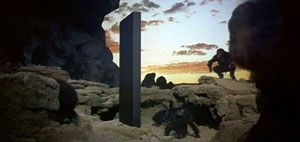 Kubrick's movie opens with a scene of the Monolith at the dawn of human life with ape-men fighting around the Monolith. (see above image)
The next scene in Kubrick's movie fast forwards millions of years to the discovery of another Monolith on the far side of the moon which emits a radio signal upon uncovering it. Knowledge of the Monolith is censored, and top secret with no media leaks allowed. A space ship is dispatched to follow the radio beacon to its destination.
Information in Both Animate and Inanimate World
Meyers would probably say there is information throughout nature in both the living, animate world and also permeating the inanimate world. Again, science has been useful in bringing this information to light.
For example, examine the laws of electro-magnetic energy which are described elegantly in Maxwell's Equations . Natural laws such as Maxwell's Equations are instructions for the behavior of the inanimate world. Much of modern science is based on these equations. An instruction set such as Maxwell's Equations contains coded information which implies an intelligence for its origin.
Information Permeates the World
Information is contained in all the natural laws science, and the laws of physics and chemistry as well. Science is concerned with finding these natural laws, and when possible, describing them mathematically, as in the equations describing the orbits of the planets or the motion of subatomic particles. All of these natural laws and their mathematical descriptions are instruction sets for the behavior of the natural world. Instruction sets represent information, and like all information, one could infer intelligence for their origin.
Reformulating the Debate
Stephen's Meyer's great accomplishment is the re-framing of this debate into a format which is acceptable to the vast population of reasonable people, a format which uses the usual tools of science, and abides by the same rules.
Is ID Science After All ?
Stephen Meyer's claims his re-definition of Intelligent Design (ID) is within the realm of science. Why? Because Meyer uses the methodology of science, making best inference from the available objective evidence. There is no reliance on subjectivity, or subjective knowledge. There is no reliance on religious scripture or religious activity. There is no appeal to the supernatural. Is Stephen Meyers correct? I will leave it up to the theologians, philosophers and scientists to decide.
What is Intelligence?
So, once we agree that the best inference is that coded instructions in DNA originated from intelligence, then what? We are left with the problem of defining “intelligence”. We think we know what intelligence is, yet once we look at the definition, we discover that we really don’t have a good scientific definition of intelligence. I suspect the reason for this is that our recognition of intelligence is somewhat subjective.
Reading Other People’s Intelligence.
For example, one of the first things we do when meeting a new person, is assess that person’s level of intelligence. Some of us have an innate ability to do this. Some of us lack this ability. When it comes to reading other people, in addition to intelligence, we are interested in other qualities in the new person. Are they a good or a bad person, are they trustworthy, truthful, capable of love, are they happy, depressed, confident, fearful? Is this new person a threat to me in any way?
Friend of Foe?
Will they be a potential ally or a foe? Intelligence is in the Subjective Realm. We can also try to assess the intelligence of animals, such as our cats and dogs that we are familiar with around the house. We can also get the feeling that there is artificial intelligence in some forms of computer software such as chess programs that exhibit a form of artificial intelligence.
Again, we do not have any instruments to measure intelligence in an objective way. IQ testing doesn't’t seem to be a very good tool. Our knowledge of intelligence seems to remain in the subjective realm. Science is concerned with the objective realm, and doesn't’t do very well with the subjective realm.
The Implications of A Non-Human Intelligent Agent.
Let's assume that we all agree that this is a valid inference, that the coded instruction set in DNA is evidence of the work of an intelligent agent.
Is the Intelligent Agent Friend or Foe?
This brings us back to popular movies like Space Odyssey or Contact in which extra-terrestrial intelligence is the subject of the movie. When primitive man came across tracks or markings indicating an intelligent agent, the intelligent agent was either another primitive human, or else an animal. Either way, the highest priority consideration is whether the intelligent agent is a threat or a friend. This is true for ANY new found intelligent agent in the wild, and must be applied to our new found intelligent agent, the originator of the information in coded DNA.
If a Foe, is the Foe Dangerous to Me?
The first thing we would ask is, "what is the level of this intelligence relative to mine or other humans?" Molecular biologists have concluded that the complexity and elegance of the coded instruction set in DNA is far in excess of anything humans could produce.
A Frightening Realization
This is a frightening realization, because, if the intelligent agent is a threat rather than a friend, then we are at a serious disadvantage. A foe with more intelligence, means a foe with better technology and better weapons.
Aging Disease and Death
It seems that the intelligent agent, if there was one, has left the scene. What can we deduce about the intelligent agent from the instructions left behind for us to decipher? Our DNA contains a coded instruction set for our pre-programmed aging, disease and death. What does that tell you about the intelligent designer? Perhaps there is another approach.
Gratitude for Life
Saying Thank You for a Trillion Cells
There is another more optimistic viewpoint based on our understanding of the coded instruction sets in our DNA. This is the miracle of life, our own individual life that began as two microscopic specks of matter containing paired instruction sets in the DNA. The underlying intelligence required for the origin of this instruction set is something the ancients understood well.
Whether we use the most powerful instruments to examine the galaxies in space or the smallest particles of the atom, or whether we use the naked eye and the five senses to examine our immediate natural world, we are confronted with the obvious conclusion that the world is permeated with intelligence. This intelligence makes all life possible, including our individual life.
This realization leads to a sense of gratitude to the Creator, and a
sense of wonder and awe. Yes, we are faced with the eventual prospect of
aging, disease and death. But until that time comes, we will celebrate
life.
Articles with related content:
Saying Thank You for a Trillion Cells
Links and References
You Tube Video of Stephen Meyers Debate with Peter Ward over ID Seattle 2008.
More Stephen Meyers You Tube Videos .
Update 2014: Stephen Meyer's New Book

by Stephen Meyers
Jeffrey Dach MD
7450 Griffin Rd Suite 180/190
Davie, FL 33314
Phone: 954-792-4663
Blog
Jeffrey Dach MD
7450 Griffin Road Suite 190
Davie, Florida 33314
954-792-4663
http://www.jeffreydachmd.com
http://www.drdach.com/
http://www.naturalmedicine101.com/
http://www.truemedmd.com/
http://www.bioidenticalhormones101.com/
For Disclaimer: Click Here
The reader is advised to discuss the comments on these pages with
his/her personal physicians and to only act upon the advice of his/her
personal physician. Also note that concerning an answer which appears as
an electronically posted question, I am NOT creating a physician —
patient relationship.
Although identities will remain confidential as much as possible, as I can not control the media, I can not take responsibility for any breaches of confidentiality that may occur.
Copyright (c) 2014 Jeffrey Dach MD All Rights Reserved
This article may be reproduced on the internet without permission,
provided there is a link to this page and proper credit is given.
FAIR USE NOTICE: This site contains copyrighted material the use of which has not always been specifically authorized by the copyright owner. We are making such material available in our efforts to advance understanding of issues of significance. We believe this constitutes a ‘fair use’ of any such copyrighted material as provided for in section 107 of the US Copyright Law. In accordance with Title 17 U.S.C. Section 107, the material on this site is distributed without profit to those who have expressed a prior interest in receiving the included information for research and educational purposes.
Serving Areas of: Hollywood, Aventura, Miami, Fort Lauderdale, Pembroke Pines, Miramar, Davie, Coral Springs, Cooper City, Sunshine Ranches, Hallandale, Surfside, Miami Beach, Sunny Isles, Normandy Isles, Coral Gables, Hialeah, Golden Beach ,Kendall,sunrise, coral springs, parkland,pompano, boca raton, palm beach, weston, dania beach, tamarac, oakland park, boynton beach, delray,lake worth,wellington,plantation